Insulated or not: how to decide for a Michigan garage
The R value on the sticker matters far less than whether the garage is attached to anything you heat.
September 16, 2026 · 3 min read
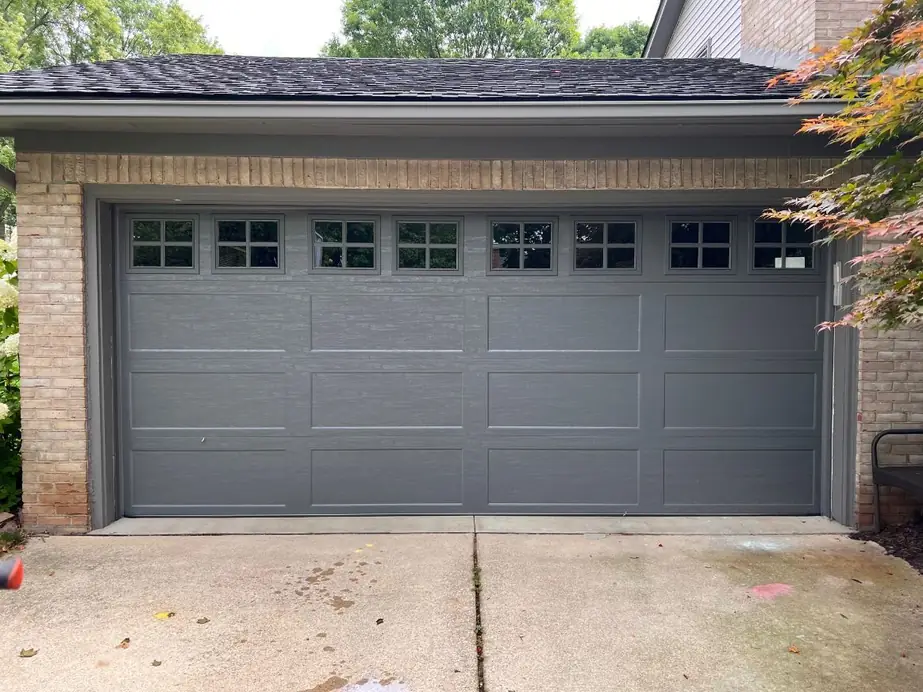
Insulation is the single most common upgrade decision on a new residential garage door, and it is the one where people most often either overspend or regret saving. The deciding factor is not the number printed on the section. It is what the garage is attached to and what you actually do in it.
Start with whether the garage is attached
If your garage shares a wall or a ceiling with heated living space, an insulated door is almost always worth it. Every winter the garage sits at some temperature between outside and inside, and the colder it sits, the harder the rooms next to it work. Bedrooms over a garage are the clearest case of all.
If the garage is detached and stores a mower and a couple of bikes, the picture changes completely. You are heating nothing, so the only thing insulation buys you is a slightly less brutal space to stand in during January. That may still be worth it if you work out there, and it is not worth much if you do not.
Insulation does things that have nothing to do with heat
An insulated section is a sandwich rather than a single skin, and that makes it considerably stiffer. On a double width door that stiffness is worth having on its own. It resists the flex that eventually cracks the stiles on a thin single skin door, and it takes a knock better.
It is also much quieter. A single skin steel door is a large flat panel that behaves like a drum, and it transmits both the sound of its own operation and the noise from the street. If there is a bedroom over the garage, the difference between an insulated door on a belt drive and a single skin door on a chain drive is not subtle.
Reading the numbers without being sold to
Door insulation is quoted as an R value. The trap is that manufacturers do not all measure it the same way, and some quote the value of the insulating material alone rather than the assembled section, which is a different and more flattering number.
A useful sanity check is the construction rather than the figure. A two inch thick insulated section is doing real work. A thin sheet of polystyrene laid into a single skin door is mostly doing marketing. Ask what the section is actually built from and how thick it is.
The gaps matter more than the panel
A well insulated door in a badly sealed opening is a waste of money, because most of the loss is going around the door rather than through it. The bottom seal against an uneven concrete floor is the usual offender, and older concrete is rarely flat.
Perimeter weatherstripping down the jambs and across the head does as much as an R value upgrade on many houses, and it costs a fraction as much. If the budget is tight, seal the opening properly and put the saving toward better hardware.
What insulation costs you elsewhere
An insulated door is heavier, which is not a problem as long as everybody accounts for it. The springs have to be sized for the actual door weight, and the opener has to be rated for it. This is ordinary and we do it as a matter of course, but it is the reason a door should not be swapped for a heavier one without the springs being reviewed.
It is also why replacing a single skin door with an insulated one and keeping the old springs is a false economy. The springs will be working outside their range from day one.
A short decision list
- Garage attached, or a room above it: insulate, and seal the perimeter properly too.
- Garage detached, used for storage only: a single skin door is usually the honest answer.
- Detached but you work out there: insulate, and think about the walls and roof as well.
- Double width opening: the extra stiffness is worth something regardless.
- Bedroom over the garage: insulate, and put it on a belt drive.
Ask for both prices
Whatever anybody recommends, ask for the insulated and non insulated price on the same door so you can see what the upgrade actually costs on your opening rather than in general. It is a small ask and it turns the decision into arithmetic instead of a judgement call.
We quote it that way as standard, and we will tell you which side of the line we think your garage falls on. Estimates on new doors and replacements are free.
Crawford Door Sales, (734) 483-4563
Call (734) 483-4563More articles
Why your garage door sounds like that
Doors rarely fail without warning. They just warn you in a language most people have not learned.
Your torsion spring has broken. Here is what not to do
The wrong five minutes after a spring breaks can turn a routine repair into a new door.